

Report Flags High Informal Farmer Credit As Key Livelihood Challenge
A comprehensive annual study on India’s economic landscape highlights persistent gaps in formal financial access despite strong macroeconomic growth.
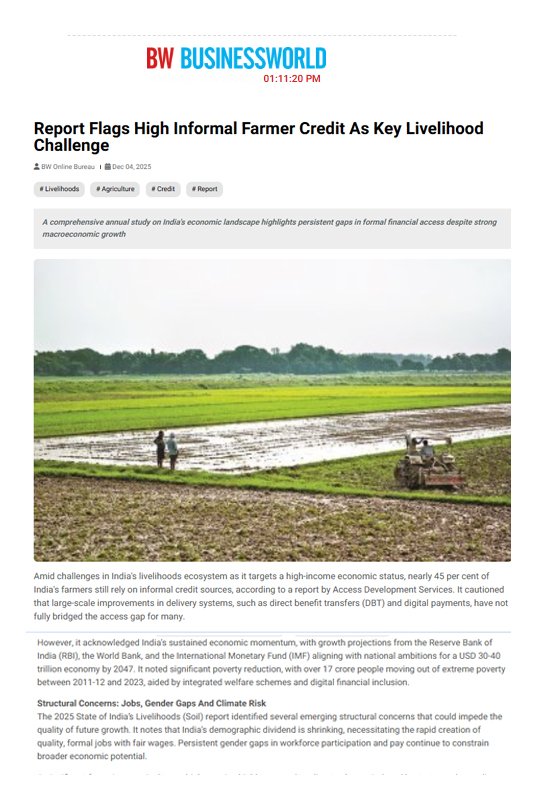
Amid challenges in India’s livelihoods ecosystem as it targets a high income economic status, nearly 45 per cent of India’s farmers still rely on informal credit sources, according to a report by Access Development Services. It cautioned that large-scale improvements in delivery systems, such as direct benefit transfers (DBT) and digital payments, have not fully bridged the access gap for many.
The report, unveiled at a national convening in New Delhi, added that documentation challenges, authentication failures and other barriers continue to prevent dependable access to formal finance and services, sustaining reliance on informal networks.
However, it acknowledged India’s sustained economic momentum, with growth projections from the Reserve Bank of India (RBI), the World Bank, and the International Monetary Fund (IMF) aligning with national ambitions for a USD 30-40 trillion economy by 2047. It noted significant poverty reduction, with over 17 crore people moving out of extreme poverty between 2011-12 and 2023, aided by integrated welfare schemes and digital financial inclusion.
Structural Concerns: Jobs, Gender Gaps And Climate Risk
The 2025 State of India’s Livelihoods (Soil) report identified several emerging structural concerns that could impede the quality of future growth. It notes that India’s demographic dividend is shrinking, necessitating the rapid creation of quality, formal jobs with fair wages.
Persistent gender gaps in workforce participation and pay continue to constrain broader economic potential.
A significant focus is on agriculture, which remains highly exposed to climate-change-induced heat stress, demanding stronger investments in adaptation. The sector is also undergoing a feminisation, with women now constituting over 64 per cent of the agricultural workforce, according to the report.
“The fact that almost 45 per cent of farmers still depend on informal f inance, and that women now make up over 64 per cent of the agricultural workforce, reflects both the pressures and possibilities shaping the livelihoods landscape,” said Vipin Sharma, Chief Executive Officer of Access Development Services.
The report showed that while enablers like the Kisan Credit Card, Unified Payments Interface (UPI) and microfinance have expanded opportunities, the rise of self-employment, now near 58 per cent and an expanding informal economy highlight the urgent need for stronger livelihood security frameworks.
In his keynote address, Manoj Mittal, Chairman and Managing Director of the Small Industries Development Bank of India (Sidbi), emphasised entrepreneurship and the micro, small and medium enterprise (MSME) sector, which provides livelihoods to nearly 30 crore people, as central to India’s poverty reduction story.
The overarching message from the report is that translating macroeconomic growth into secure, dignified and climate-resilient livelihoods for every household remains the fundamental challenge for India’s development trajectory.