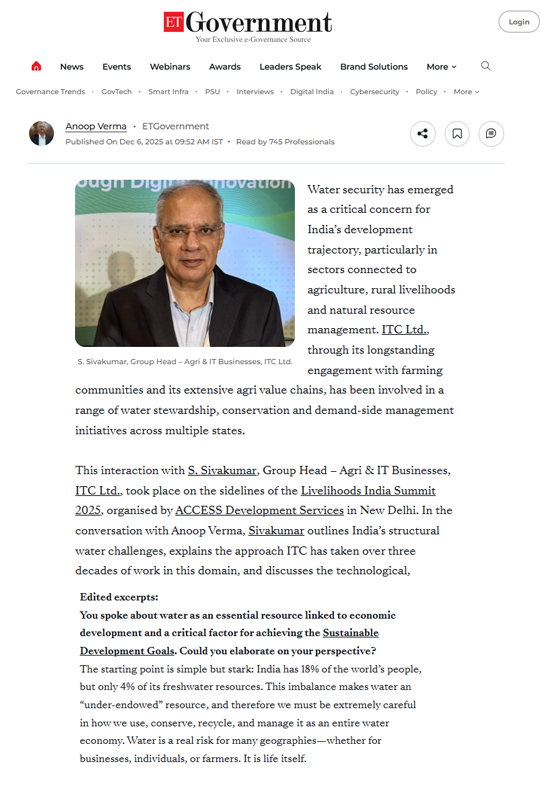


From river basins to farm ponds: How ITC works with communities on water security
A detailed look at India’s water stress, the need for community-led governance, and how supply- and demand-side interventions, technology, and basin-level planning can strengthen long-term water security.
Water security has emerged as a critical concern for India’s development trajectory, particularly in sectors connected to agriculture, rural livelihoods and natural resource management. ITC Ltd., through its longstanding engagement with farming communities and its extensive agri value chains, has been involved in a range of water stewardship, conservation and demand-side management initiatives across multiple states.
This interaction with S. Sivakumar, Group Head – Agri & IT Businesses ITC Ltd., took place on the sidelines of the Livelihoods India Summit 2025, organized by ACCESS Development Services in New Delhi. In the conversation with Anoop Verma. S. Sivakumar outlines India’s structural water challenges, explains the approach ITC has taken over three decades of work in this domain, and discusses the technological, institutional and community-level mechanisms required for more efficient and sustainable water governance.
Edited excerpts:
You spoke about water as an essential resource linked to economic development and a critical factor for achieving the Sustainable Development Goals. Could you elaborate on your perspective?
The starting point is simple but stark: India has 18% of the world’s people, but only 4% of its freshwater resources. This imbalance makes water an “under-endowed” resource, and therefore we must be extremely careful in how we use, conserve, recycle, and manage it as an entire water economy. Water is a real risk for many geographies—whether for businesses, individuals, or farmers. It is life itself.
Through water user groups and FPOs, we build community capacity, provide technical assistance, link them to government schemes, and invest our own resources to create water structures—check dams, bunds, farm ponds and more. This supply-side intervention has enabled irrigation across 1.5 million acres and created a water storage potential of around 60 million cubic metres.
What about the demand side of water management, particularly in agriculture?
After decades of supply-side work, we realised that demand-side management is even more critical. Working with farmers, scientists, universities and our own research teams, we help them adopt agronomic practices that use less water and often produce better quality crops.
The challenge is that conserving water does not directly translate into monetary gains because water and power are hardly priced in India. Therefore, we demonstrate how precision irrigation improves crop quality, ensures critical irrigation during stress periods, and ultimately increases income. Through these interventions across our sourcing areas, annual water savings have reached 1,400 million cubic metres—many times more than the cumulative supply-side gains of 30 years.
You also mentioned river-basin level interventions. What does ITC do at that scale?
Managing water only at farm or village level is not enough. Water flows across entire river basins. Therefore, we work in priority river basins – identified either by ITC or by government agencies—to make them net water-positive by combining supply-side and demand-side measures.
So far, we have worked across five river basins. Our scale and experience also allow us to work with several state governments to train their officers so they can expand these interventions. While ITC builds the first model, government partnerships help replicate it widely.
ITC is one of India’s largest agribusiness companies. Your work with farmers must give you deep insights into water challenges. What are the key challenges India faces in this area?
The biggest challenge is enabling farmers to see individual value in adopting water-saving practices. Saying “save 100 litres of water” does not motivate behavioural change. But if farmers see that saving water improves crop quality, reduces fertiliser use, or increases income, then adoption becomes natural.
Therefore, the crucial challenge is translating a common-resource conservation goal into individual economic gain. This requires micro level technologies, crop-specific agronomic practices, and clear demonstration of benefits.
Property rights over water are complex. Do you think India needs stronger regulation for water governance?
Regulation is important, but self-governance is far more effective. Regulation often ends up being controlled by a dominant few. Real water governance happens when communities form water user groups, pool resources, understand their hydro-geological realities, and decide on—form ponds, check dams, tanks—based on local needs.
When everyone contributes—farmers, government programmes, ITC—it ensures account ability and empowerment. Registration and dispute resolution mechanisms are needed,
yes, but the core lies in building democratic, self-governing water institutions at the grassroots.
India often looks to Israel for advanced water technologies. Do we have adequate technology within the country, or do we need to import solutions?
We have been long-time partners with Israel, and their technologies are valuable. Many Israeli companies have established operations in India, including through the I2U2 partnership (India, Israel, US, UAE). But India is also advanced in several water technologies, and innovations continue to evolve globally.
Technology is not the limiting factor. We already have many effective solutions. The real challenge is awareness and adoption—by households, farmers, urban consumers, and factories. People must understand the value of these technologies and the implications of not using them. Continuous innovation, industry efforts, and government collaboration keep the pipeline strong.